The Netherlands is cutting agricultural carbon emissions, reducing food waste, and raising healthier livestock. All within a single, circular system. Here’s how it works.
The Floating Farm is a selfsufficient, waterbased agricultural model designed to strengthen the resilience of urban food systems. Traditional supply chains are long and increasingly vulnerable to disruption; when events like flooding occur, they can trigger bottlenecks that ripple through every stage of the chain. The Floating Farm offers a way to shorten that distance and protect cities from these growing risks. Many cities are built close to water as it’s an important settlement factor; therefore, the Floating Farm focuses on building food production facilities on water to localise production.
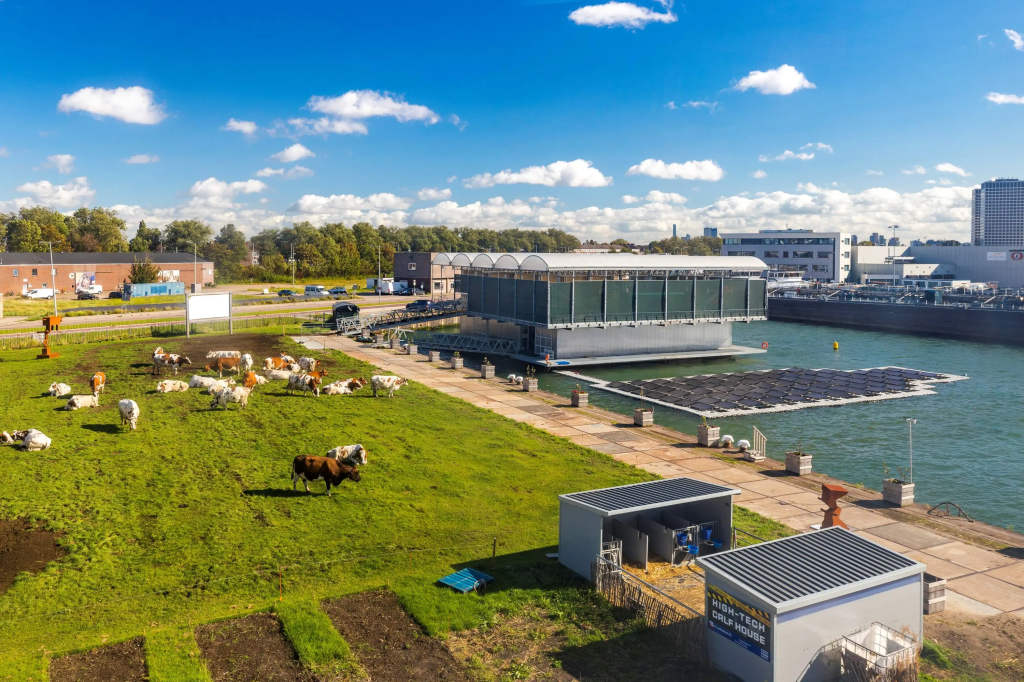
The first Floating Farm was built in the old part of the Rotterdam port in the Netherlands, aiming to supply high-quality dairy products to local consumers, whilst simultaneously educating the city on the importance of localised supply chains. The founders of Floating Farm identified some main challenges to lengthened food supply chains:
- Resilience: especially with climate change having a significant impact of weather systems, disruptions not only occur in the production of food but also in transportation
- Sustainability: the longer a food supply chain is, the more transport it requires to get to its destination, which is usually the biggest culprit of CO2 emissions. Furthermore, the longer food is in transportation, the more likely it is to become out-of-date or damaged, which creates large amounts of waste, further increasing the carbon footprint.
- Health: often, large corporations spray their crops with pesticides, to stop other animals eating produce, and preservatives to make it last longer through transportation and shop-floor activities. Neither of these chemicals are natural and can have sever health effects. We are the only species who chemically treat our food to stop other animals eating it, to then eat it ourselves.
The Floating Farm aims to challenge these ways of food production by enhancing the resilience of supply chains, maintaining the nutritional value of produce, and reducing the carbon footprint of our dinner plates. All while empowering local producers.
So, what does the Floating Farm look like…
Construction began in 2018 with a business-to-business model in mind. When the global pandemic disrupted this approach, they switched to a business-to-consumer strategy instead. Today, they sell directly from their on-site farm shop as well as through their online store.
A floating business may sound unconventional elsewhere, but in the Netherlands, it fits naturally into the landscape. Rotterdam, with 90% of its area below sea level, has long experimented with living and building on water. Floating houses, pavilions and even small forests are now woven into the city. A notable example is the Global Centre on Climate Adaptation, a purpose-built floating structure that demonstrates how cities can adapt to a changing climate.
…and how does it work?
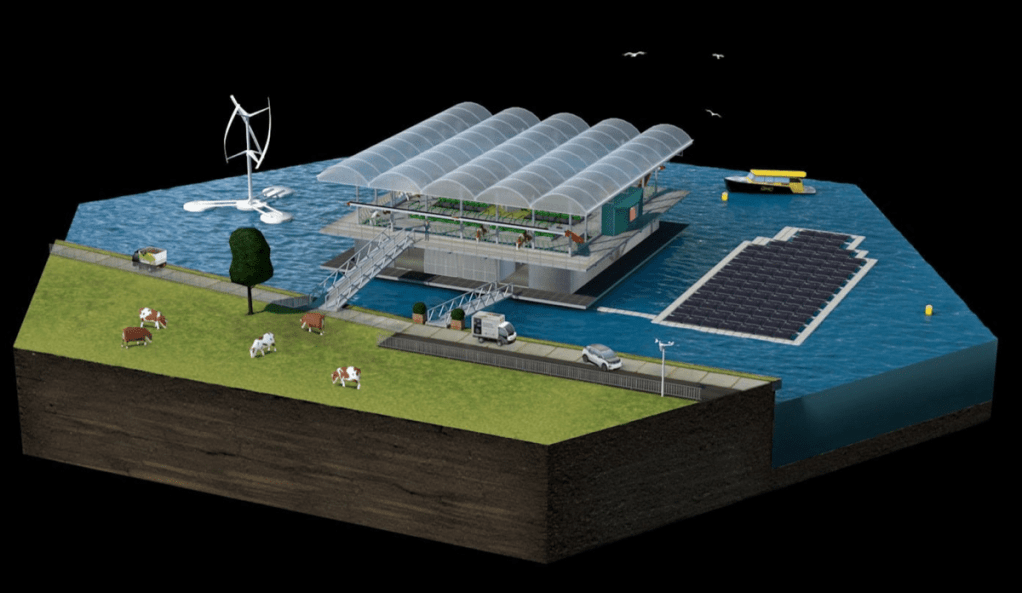
The cattle on this farm are free to roam across the floating barn and venture on shore to graze whenever they like. The floating structure is designed to stay stable and move gently with the movement of the water. As of today, 40 cows live on the top floor, which includes a pasture-like area, resting
spaces and feeding stations. However, instead of relying on imported feed, the farm uses brewery grain from local breweries, leftover bread from bakeries, and grass clippings from football fields to create high-value cattle feed. This closed-loop system means the cows are almost entirely fed from city by-products that would otherwise go to waste. So, not only does the Floating Farm initiative reduce land usage and transport emissions, but it also reduces the amount of waste from the city that would otherwise head to landfill.
The farm produces dairy products; however, unlike conventional dairy farming, cows choose when to enter the robotic milking station. From there, the milk is processed on the floor below and made into fresh milk, yoghurt and butter. This produce is sold directly in the city, keeping the supply chain short and the carbon emissions minimal. Obviously, cows produce waste, the majority of which is turned into fertiliser for Rotterdam’s public green spaces, but a small percentage is turned into biobased products such as plant pots.
Finally, the bottom floor houses a vertical farm that grows microgreens and herbs. This method uses 85% less water than traditional growing methods and is pesticide-free.


Leave a Reply