
More and more milk options appear every time I step foot in the supermarket, from cows milk to pea milk, the possibilities are almost endless. But which is best? This blog gets to the bottom of which milk is most sustainable.
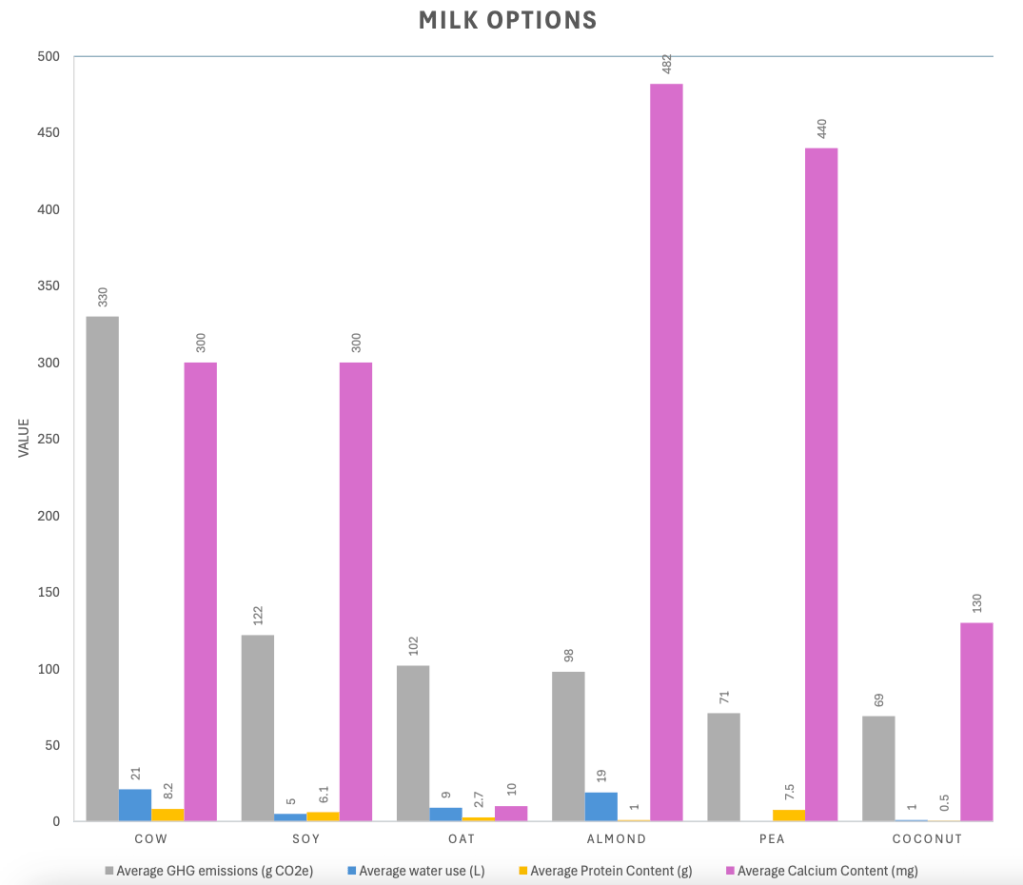
The following graph presents data gathered from AlgaeCal and the Current Environment Health Report 10, representing the average greenhouse gas emissions, water usage, protein content and calcium content of a glass of milk (240ml). Protein and calcium contents were chosen as they are the two nutritional values people tend to look for when consuming milk.
Cows Milk
At first glance, cows’ milk produces the highest amount of carbon emissions per glass, but when compared to its nutrient content, these values are significantly lower. This suggests that if you consume milk for the nutrient content, then it is far more eco-conscious to drink cows milk over alternatives like coconut or oat milk as the amount you would need to drink to reach your goal creates a larger effect than just drinking conventional milk.
Oat Milk
Oat milk has the lowest calcium content out of all the options presented, and per 1mg of calcium, it also has the highest carbon emissions (10.2 g) and water usage (0.9 L).
Soya Milk
Soy milk holds a strong case for its protein content, with 6.1g of protein per glass and only 5L of water, however, it does produce the second highest carbon emissions at first glance. Soy milk also contains the same amount of calcium as cows milk!
Almond Milk
It can be seen that almond milk presents the worst sustainability profile, with a single glass requiring 19 litres of water and producing 98g of CO2e for only 1g of protein. Having said this, per 1g of protein, almond milk contains the highest value of clcium (482mg).
Pea Milk
Pea milk contains the closest protein content to cows milk (7.5 compared to 8.2 respectively), however, the research into the wider impacts of pea extraction and production is limited and therefore, we must take the minimal facts with a pinch of salt. That being said, pea milk also offers one of the smallest green house gas emissions out of the options, with cows’ milk emitting 4.6 times more carbon emissions
Coconut Milk
Coconut milk has the smallest footprint but also the smallest nutritional value, so to get the same nutritional value as cows milk, you would need to drink 16.4 glasses which would produce 1,131.6g of CO2 emissions! Far higher than a glass of cows milk (330g CO2e), this therefore does not present a sustainable options for the planet or ourselves.
Conclusion
The results from this analysis vary depending on the component of milk you value the most (protein or calcium content). It is clear that coconut milk is the least sustainable option in terms of GHG emissions when you are looking for the highest possible protein content, but when looking for the highest possible calcium content, pea milk produces the lowest carbon emissions. On the other hand, water usage is lowest in coconut milk is lowest when measuring calcium per mg, but in soy when analysing protein per gram.
Overall, I would conclude that soy milk is the most sustainable milk option as it provides the same value of calcium as conventional cows milk, but also shows low or relitevly low water usuage and carbon emissions in both cases. However, your impact will vary depending on what you wish to get from consuming milk.
Don’t forget, your impact doesn’t stop with the type of milk you buy; the packaging it comes in and the location at which it is produced all contribute to the complete impact. I have yet to see an alternative milk option in a supermarket which is packaged in a glass bottle.
Raw data
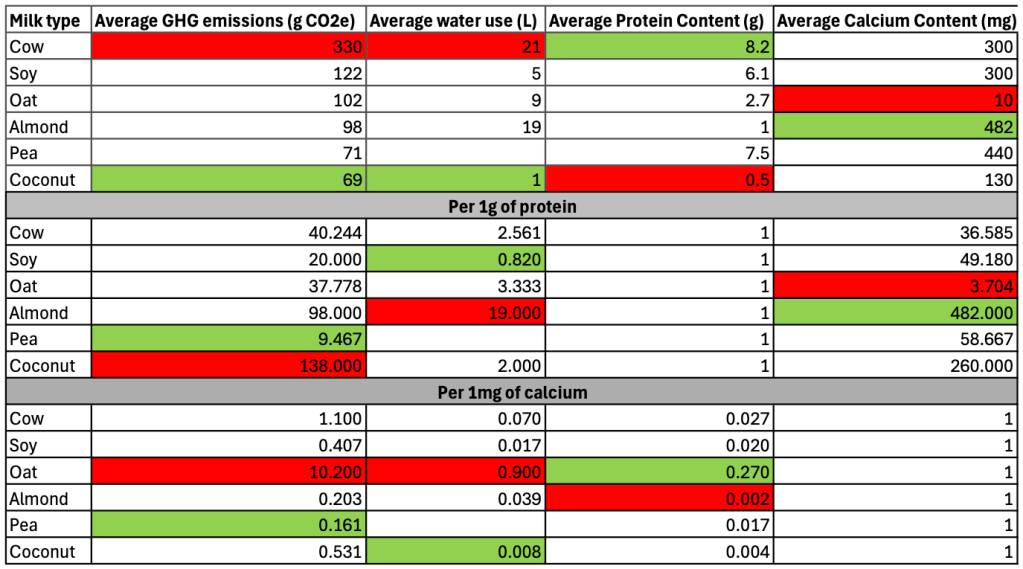
Green: best option in category
Red: worst option in category
Comment what your milk of choice is!
 Not My Monkey
Leave a comment