After being invited to a wedding, it got me thinking about how we can make weddings more eco-friendly. So, after scouring my brain and the internet, here are the results.
Venue and Travel
A quarter of UK weddings are taken abroad, and with an average guest list of 82, this creates 19,188 kg of CO2 emissions from the flights alone (calculated from the UK to Italy)! This is equivalent to 4.5 cars driven for a year. This is not to say your wedding can’t be everything you imagined, but rather than flying abroad, is it possible to take a boat or train? This also applies to the honeymoon.
Decorations
Most often, decorations at weddings are used once and never seen again, not to mention the plastic they come wrapped in. Therefore, making your own or renting decorations is a great way to reduce waste at a wedding, to take this further, use local businesses for materials or renting. Bunting is perfect for this! Furthermore, balloons and confetti are a popular choice at celebrations, make sure these are biodegradable to avoid harming animals and ecosystems.
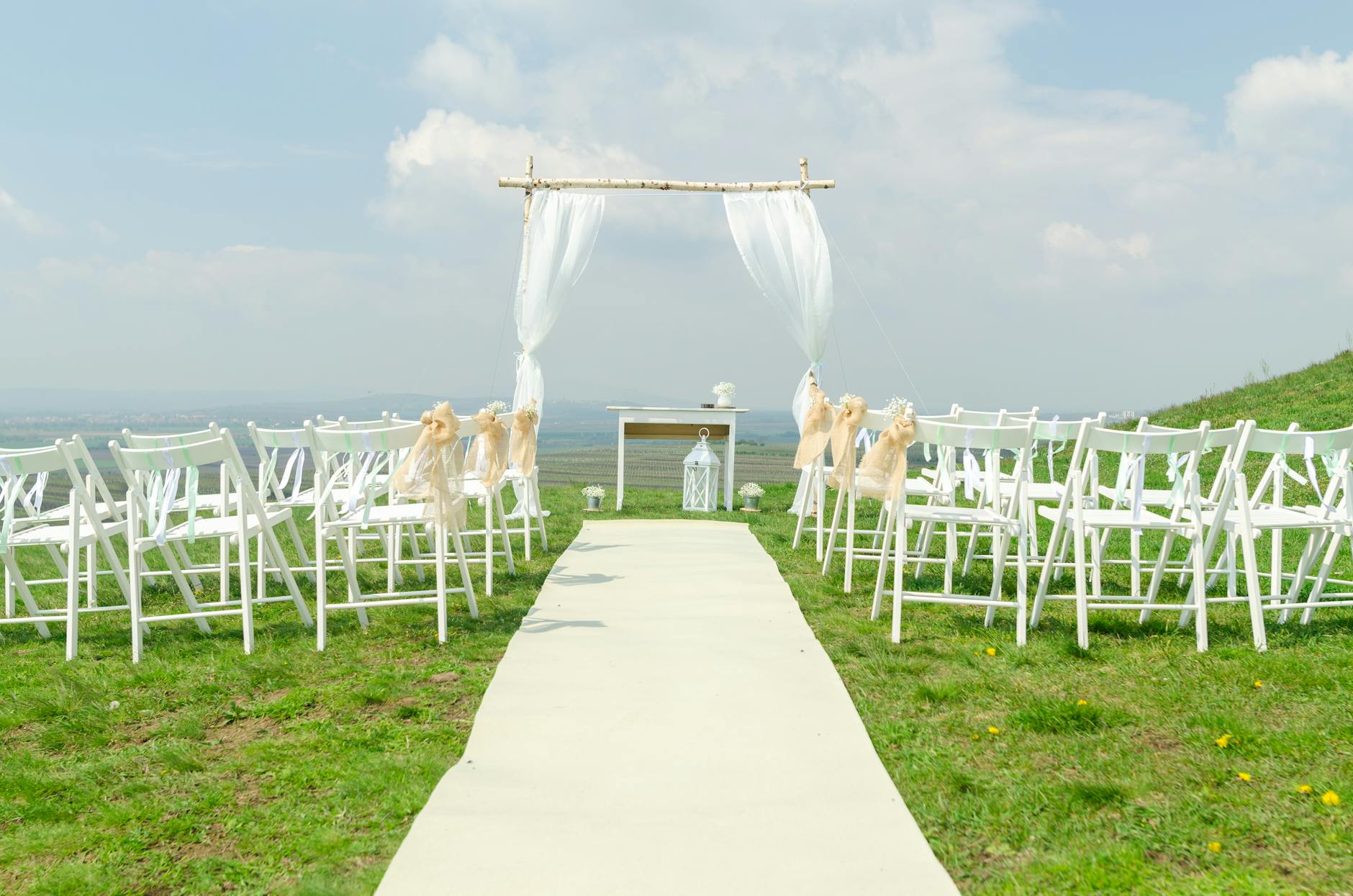
For an isle runner, dried petals or leaves fallen from local plants is a great alternative to plastic petals as they can be returned to the outdoors to decompose.
Outfits
Obviously, the outfits are a huge part of a wedding, from dresses to suites, there are a myriad of ways to make sustainable choices. One is renting a dress and/or suit to allow many people to love the same outfit as you do. Whilst many people keep their wedding outfits, this method reduces resource demand (i.e., energy, materials, water and labour). However, if you’re set on having a new outfit for your special day, try to be conscious about where you buy from. Look out for the sustainable practices they use (e.g., recycled materials and water-saving methods), and if possible, choose someone local who uses locally sourced materials. Another option is to use an outfit (most likely a dress) handed down from family or loved ones and have it reimagined into something your style if it isn’t already! This is something I’d love to do.
Invites
While it is traditional to send paper invites, these unfortunately present many opportunities to increase your carbon footprint. First, the paper contributes to deforestation and the dispersion of invites requires travel. If you can distribute invites yourself by walking or cycling, printing invites on recycled paper may be a minor sustainable adjustment. However, if you have a large guest list who are not all local, it may be more beneficial to send e-invites to avoid travel and material use. Some invitation companies are even offering to print invites on seed paper which can be planted to boost local biodiversity.
Food
It’s always a great idea to make the catering at a wedding vegan, however, this isn’t up everyone’s alley. Making sure the produce is local and organic is important to reduce the carbon footprint of each plate and is more likely to be nutrient-rich and fresh. It is equally important to make sure there isn’t too much food, which will inevitably be wasted at the end of the day, this includes the cake!
Gift list
Making a list of gifts you’d like to receive at your wedding is a step towards reducing the amount of waste, however, to take this further think about what you really need. Could you replace some of the physical gifts for experiences or donations to charities on your behalf?
Rings
Choose to buy your wedding rings from retailers which track where the materials have come from to ensure the extraction is not fueling conflict.
These don’t just apply to weddings, they are applicable to any celebration, try implemeting a few at your next gathering!
 Not My Monkey
Leave a comment