

“Most businesses that produce material goods, like us, are a part of the problem, and therefore also need to be a part of the solution”
It is rare to hear a statement like this, especially from international giants with large upstream and downstream operations. Not only have Volvo realised its responsibility in the climate crisis, but they have also taken significant steps to create and implement a vision which contributes to a sustainable future.
The main aspect of Volvo’s vision is creating a fully circular economy by 2040. The drivers for engaging in such regenerative change include:
- The scarcity of natural resources
- The increased cost of resources due to their scarcity
- Environmental and social impacts of producing cars, particularly in the mining and processing phases – 80% of ecosystem and biodiversity impacts occur in production
Volvo has created many milestones to measure the progress of becoming a circular business. These include: (1) by 2025, 25% of materials in new car models will be recycled or bio-based; (2) 99% of all waste is to be reused or recycled by 2030; and (3) reduce water consumption by 50% in in-house operations by 2030.
An aspect I’d like to focus on is the remanufacturing of materials, this is the main step in differentiating a recycling economy from a circular economy. The process of remanufacturing gives materials a new life by restoring them to be used again in the same way or in a newer, upgraded product. Engines, gearboxes and filters are the most common parts to remanufacture in the automotive sector, Volvo found that this process uses 85% fewer raw materials and 80% less energy than conventional manufacturing methods. Additionally, in 2022, Volvo saved almost 5,000 tonnes of CO2 by remanufacturing 33,000 parts. This process is shown in the wider circle on the diagram below.
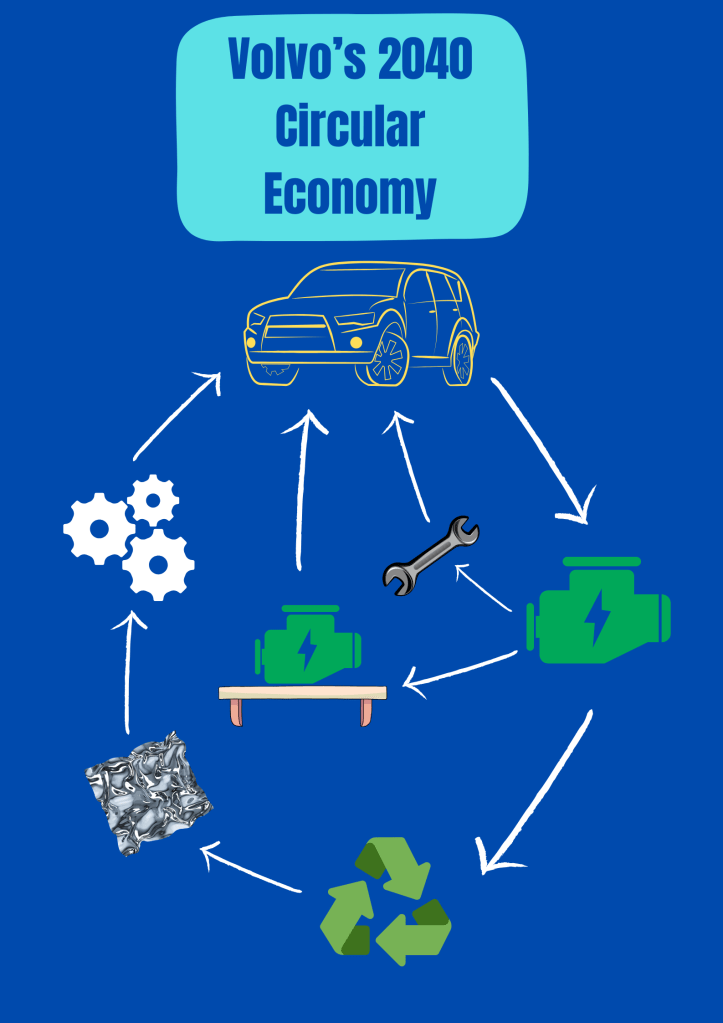
This visualises the circular economy of an electric car battery. First, the battery is removed, if possible, it is repaired and put back into the car. However, if the car is out of service the battery will either be stored and put into another car, or the materials will be separated and remanufactured into another component, which is then put into a new car model.
Designing products to be durable, reusable, and recyclable through circular economies maximises resources, this is vital for reducing natural resource dependency, it is estimated that resources such as oil will deplete in the next 30 years. Furthermore, renewable initiatives have significantly fewer negative impacts, if not net positive, reducing carbon footprints and working towards restoring the Earth’s systems.
Businesses must realise their role in driving change, in addition to understanding that sustainability is key to future success as access to natural resources rapidly declines and the Earth’s boundaries are pushed further past their thresholds. More corporations need to embrace similar visions before we enter a too-little, too-late phase where our actions cannot be reversed. No other major car retailer has set out ambitions like this, and considering the transport sector has the highest contributions to direct releases of greenhouse gasses, this is unacceptable. So, whilst Volvo is on track to win the race to embrace a circular economy, we cannot truly celebrate until others follow suit and we collectively combat the crises we face.

 Not My Monkey
Leave a comment